
The work of change continues long after a decision has been announced. Its real test comes when priorities compete, information is incomplete and the new approach must survive the pressures of everyday work. At that stage, leadership depends on the quality of judgement and the discipline of follow-through.
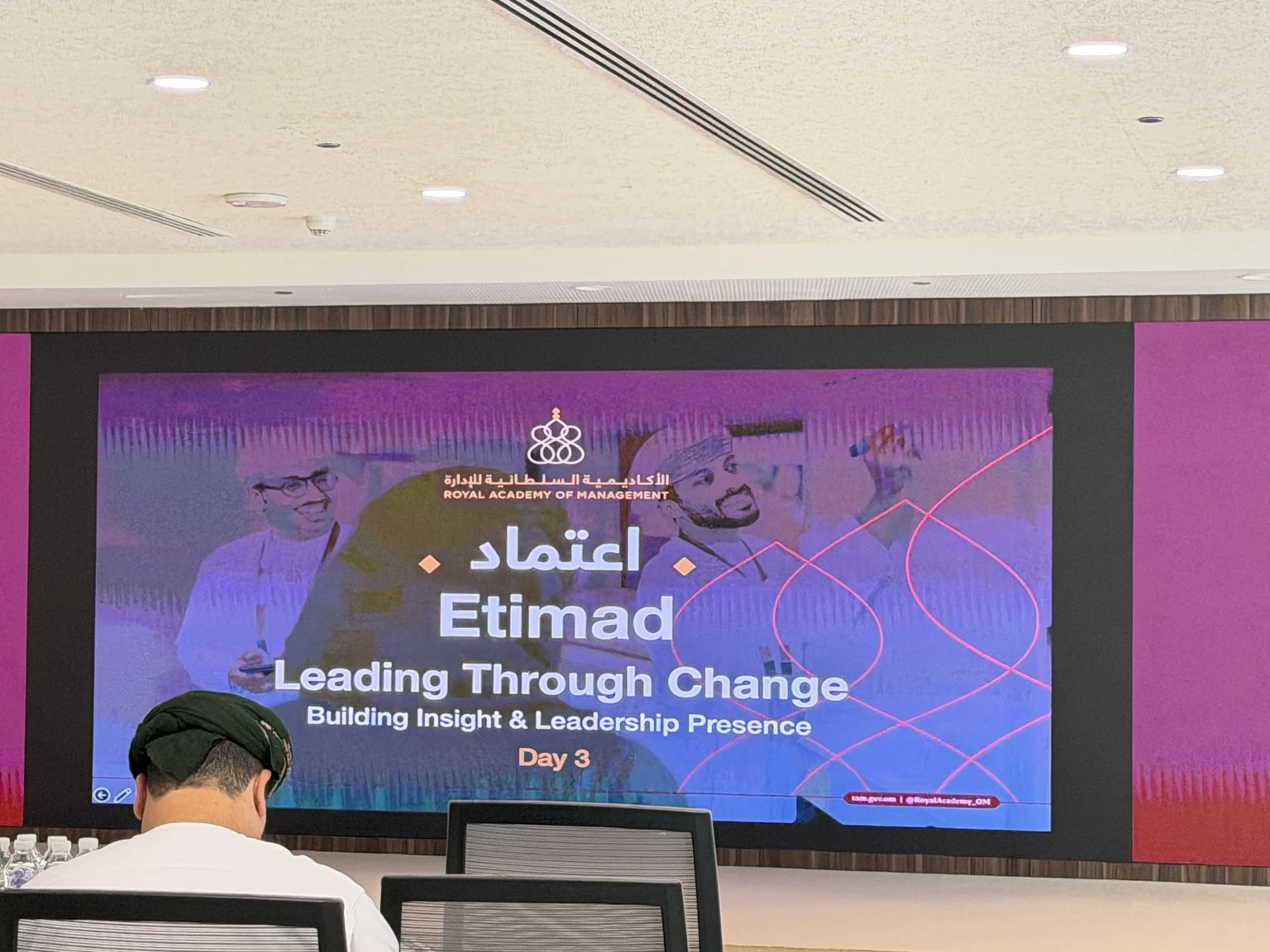
The third day of Etimad’s Leading Through Change module brought these responsibilities into focus: deciding under pressure, making change stick, measuring adoption and planning the next steps. After exploring how to understand a challenge and mobilise people around it, the practical question becomes how to turn that effort into a way of working that lasts.
Match the decision process to the consequences
Pressure can create a misleading sense that every decision deserves an immediate answer. Equally, uncertainty can become a reason to delay action long after a useful next step is available. Good judgement requires distinguishing between decisions that can be adjusted and commitments that would be difficult or expensive to reverse.
A limited trial of an internal reporting process, for example, can usually be reviewed and refined. A major commitment affecting people, contracts or long-term capacity requires deeper scrutiny. Both deserve care, but the scale of that care should reflect the consequences, the available evidence and the cost of waiting.
For a reversible decision, a useful approach is to set boundaries: what will be tested, who is responsible, how long the trial will run and what would trigger a review. This creates room to learn while keeping the exposure manageable. For a harder-to-reverse choice, the task is to examine assumptions, consider alternatives and understand what could go wrong before committing.
The distinction is useful because it makes uncertainty more manageable. A leader does not need complete information to take every step. They do need to know which unknowns could materially change the decision and which can be resolved through a controlled first move.
Make room for independent judgement
A room full of agreement is not always evidence of a strong decision. People may share the same assumptions, defer to the most senior voice or hesitate to question a direction that already appears settled. Under pressure, these habits can narrow the discussion precisely when a wider view would be valuable.
One practical discipline is to ask people to form an initial view independently before the group discusses its options. Another is to invite a credible alternative and examine the evidence that would support it. The purpose is to improve the reasoning behind the choice and expose weaknesses while they can still be addressed.
A pre-mortem offers another useful test: assume the initiative has failed and ask what might have caused that failure. Perhaps a dependency was overlooked, the workload was underestimated or a key assumption proved wrong. Exploring these possibilities before implementation can reveal safeguards that an optimistic discussion would miss.
This process should end with clarity. Once the decision is made, the people responsible need to understand its rationale, the limits of their authority and the conditions under which it should be reconsidered. A careful discussion has little value if it leaves execution ambiguous.
Build the new practice into ordinary work
Making change stick requires attention to the environment in which people work. A new approach competes with established routines, deadlines and familiar shortcuts. If the old method remains easier to use, it can return quietly even when the new direction has formal support.
The response needs to be practical. Responsibilities should be clear, the required tools should be available and the new behaviour should fit the workflow. Managers also need to examine what they reward. Asking for careful analysis while consistently praising only speed sends a message that no launch presentation can correct.
Consider a new process for approving requests. Training may explain how it works, but sustained use also depends on clear approval limits, a workable turnaround time and a route for exceptions. If urgent requests routinely bypass the process without review, the exception can become the normal practice.
Leaders establish credibility by following the same standards they expect from others and addressing friction when it appears. Early difficulties can provide useful evidence about what needs to improve. Treating every difficulty as a failure of commitment makes it harder to learn from implementation.

Measure adoption and its effects
Activity is easy to count. Attendance at training, accounts created and guidance circulated all show that work has taken place. They offer limited evidence, however, that people are using the new approach consistently or that it is producing the intended improvement.
A stronger review follows the change through several stages. Are the relevant people using the process? Are they using it correctly? Is it improving the outcome that justified the effort? A high completion rate may conceal workarounds, repeated corrections or a burden that has simply moved to another team.
Measures should therefore be considered together. A shorter approval time is encouraging, but it needs to be read alongside error rates and the quality of the decisions made. A rising volume of completed requests means less if unresolved exceptions are accumulating elsewhere. These counterweights help prevent a single target from distorting behaviour.
Early indicators can show whether the new practice is taking hold before final outcomes are visible. Later results help establish whether it has delivered value. Both need context: a change in the numbers should prompt investigation into the cause, rather than an automatic conclusion that the initiative has succeeded or failed.
Turn the learning into a clear next step
Action planning gives these ideas a practical form. A useful plan identifies the behaviour to change, an accountable owner, the support required and a review point. It also specifies what evidence would justify continuing, adapting or stopping the approach. Without these choices, a plan can become a list of intentions with no clear basis for judging progress.
The day’s agenda also included the Change Quest simulation, providing an exercise context for considering how decisions, influence and timing interact. The broader lesson is relevant to everyday management: the same action can have very different effects depending on who is involved, what has happened before and whether the organisation is ready for it.
For me, the value of this final day lies in the connection between judgement and implementation. A sound decision needs a workable process around it, and that process needs evidence and review. Leadership continues through each adjustment, especially when the initial enthusiasm has passed.
Across the three days, the sequence is clear: understand the challenge, mobilise the people involved and establish the conditions for lasting progress. The responsibility now is to bring that discipline into ordinary decisions, where the quality of change is ultimately determined.
Continue the conversation
Have an opportunity or perspective to share? I welcome a clear introduction.