
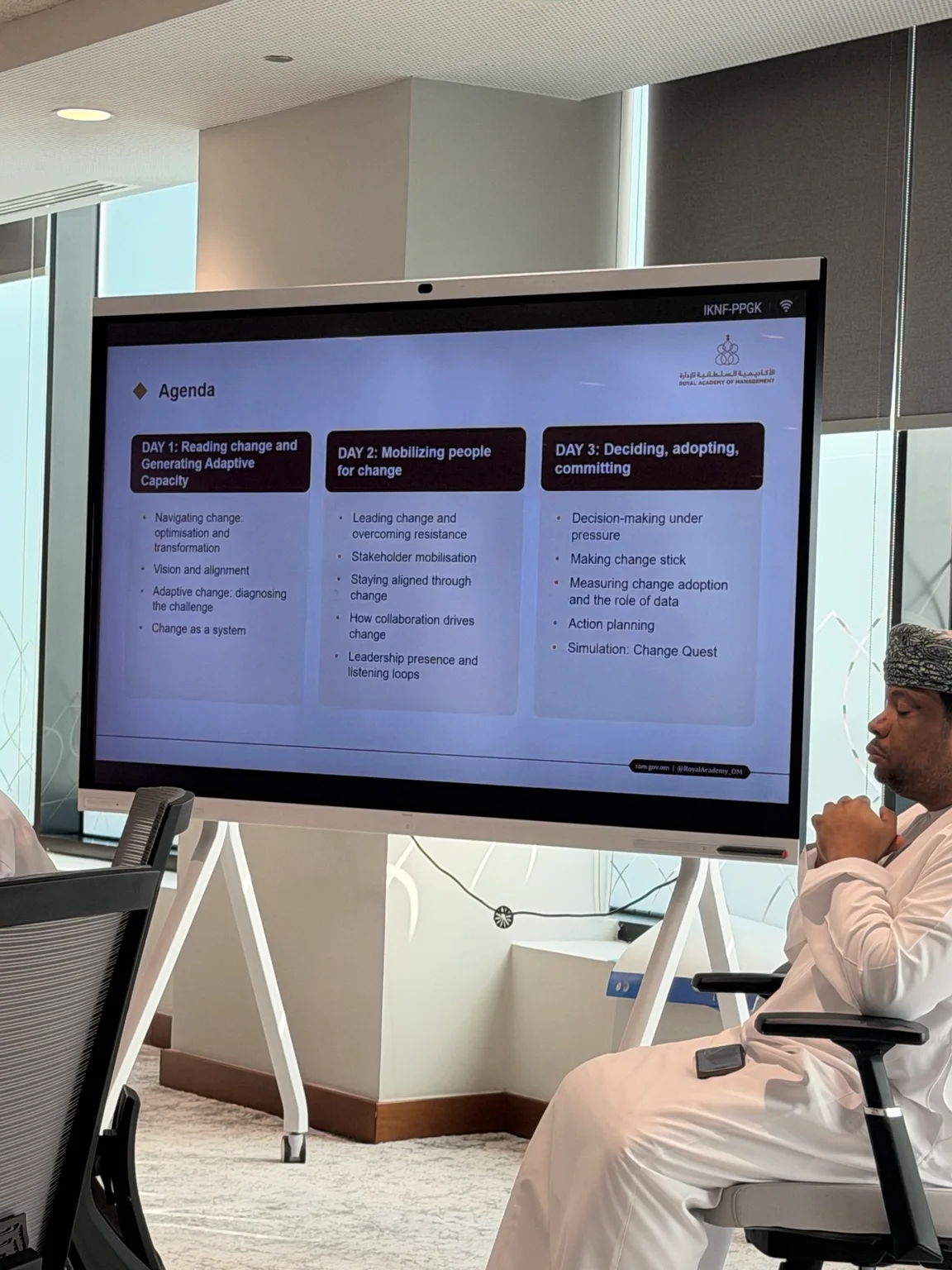
The first day of Etimad’s fourth module, “Leading Through Change,” offered an opportunity to step back from the pace of daily decisions and examine how change is approached. The question that stayed with me was straightforward: how well do we understand what we are trying to change before we decide what to do?
In business, there is often pressure to move quickly. A problem appears, a solution is proposed, and attention turns to implementation. That urgency can be useful. It can also leave important assumptions unexplored. The session encouraged a more deliberate starting point: understand the challenge, be clear about the intended result, and consider what people will need to make progress.
Understanding the change
One useful distinction was between optimisation and transformation. Improving an existing process can deliver considerable value. There may be delays to remove, errors to reduce or a service to make more reliable. Transformation involves a deeper examination of how the organisation works and creates value. Recognising which is required helps determine the scale of the response and the effort it deserves.
Technology provides a practical example. Introducing a new system may make information easier to access, but its value depends on the decisions and responsibilities around it. If the same unclear approvals and duplicated work are carried into the new platform, much of the original difficulty may remain. Before choosing the tool, it is worth examining the work itself: who needs the information, who acts on it, and where responsibility changes hands.
This leads to another important consideration: diagnosing whether a challenge is technical, adaptive or a combination of both. A technical requirement can often be addressed through specialist knowledge, defined standards and a detailed plan. An adaptive challenge requires people to reconsider established habits, assumptions or ways of working. Recognising that distinction helps a leader judge what can be planned in advance and what will need to be learned through experience.
A project can contain both. Its technical elements may need firm milestones, while its human and operational elements benefit from shorter periods of testing and review. I found that distinction useful because it allows for discipline without assuming that every answer will be available at the beginning. A small trial can reveal where a proposed approach creates confusion or adds unnecessary work, giving the team a chance to adjust before extending it.
Turning direction into shared understanding
Clarity of direction was another central theme. A priority may be well understood by the person who sets it and interpreted differently by the people responsible for carrying it out. An instruction to improve customer service, for example, might mean faster responses to one team, more detailed information to another, and greater flexibility to a third. Each interpretation may be reasonable, yet the combined effort still needs a shared purpose.
Leadership therefore involves explaining what a priority means in practice and checking how it has been understood. Asking a colleague to describe the intended result and their proposed approach can reveal gaps that a simple confirmation would miss. It also creates space for information to travel back: practical constraints, conflicts between responsibilities, or details that were not visible when the direction was first set.
This is particularly relevant when work passes between departments. The customer experiences the entire process. A team may complete its own task efficiently while the next team waits for information or repeats a check. Looking across those handovers can reveal why an organisation is busy without delivering the improvement it intended. Shared understanding needs to extend to how the work connects.
Defining the intended improvement
Defining the intended improvement is part of diagnosing the challenge. Activities such as installing software, delivering training or introducing a reporting format provide identifiable milestones, but the purpose needs to be established before those activities begin. What should become easier, more reliable or more effective? Are we trying to improve the timeliness of decisions, the quality of information or the customer’s experience? Answering these questions gives the change a direction against which proposed solutions can be assessed.
Choosing the right measure matters for the same reason. If a service team is assessed only by the number of customer requests it marks as complete, the measure may encourage speed at the expense of resolving the customer’s concern. An apparently positive figure could conceal repeat contact or unresolved concerns. Considering what a measure might encourage is part of designing the change, along with deciding what it should record.
Considering the whole system
The session’s emphasis on systems helped connect these ideas. An intervention in one part of a business can create consequences elsewhere. Removing an approval step may shorten a process, for example, but leaders still need to understand its purpose. A useful improvement considers the benefit, the control being changed, and the effect on the next person in the chain.
There was also an important reminder about the capacity of teams to absorb change. Several worthwhile initiatives can become difficult to manage when they arrive together. Each asks for attention, learning and adjustment alongside existing commitments. A slow response may reflect that pressure. Before interpreting it as unwillingness, leaders need to understand what people are already being asked to carry.
For me, this makes sequencing a substantive leadership decision. Choosing what happens first, what can wait and what existing work should end gives a priority credibility. It helps people see where to direct their effort and allows new practices time to become familiar. The pace of change should be considered alongside its ambition.
Taking the learning forward
What I value in a learning experience such as Etimad is the opportunity to revisit familiar management questions with greater precision. The contribution of this first day was practical: a clearer way to diagnose a challenge, examine the connections around it and consider the experience of those expected to respond. My thanks to Neil Perkin and the Etimad team for creating that opportunity.
I am taking forward a more deliberate question before the next initiative: what needs to improve, and what conditions will help people achieve that improvement? Answering that well requires judgement, clear communication and the willingness to revise an approach as understanding improves. Those are responsibilities that continue throughout the work.
Continue the conversation
Have an opportunity or perspective to share? I welcome a clear introduction.